


Is Your AC Worth Fixing? Here’s How to Decide Fast
When it comes to the ac repair vs replace — decision guide every homeowner eventually needs, the answer usually comes down to four things: your unit’s age, the cost of the repair, how often it’s been breaking down, and how well it’s actually cooling your home.
Quick Answer: Should You Repair or Replace Your AC?
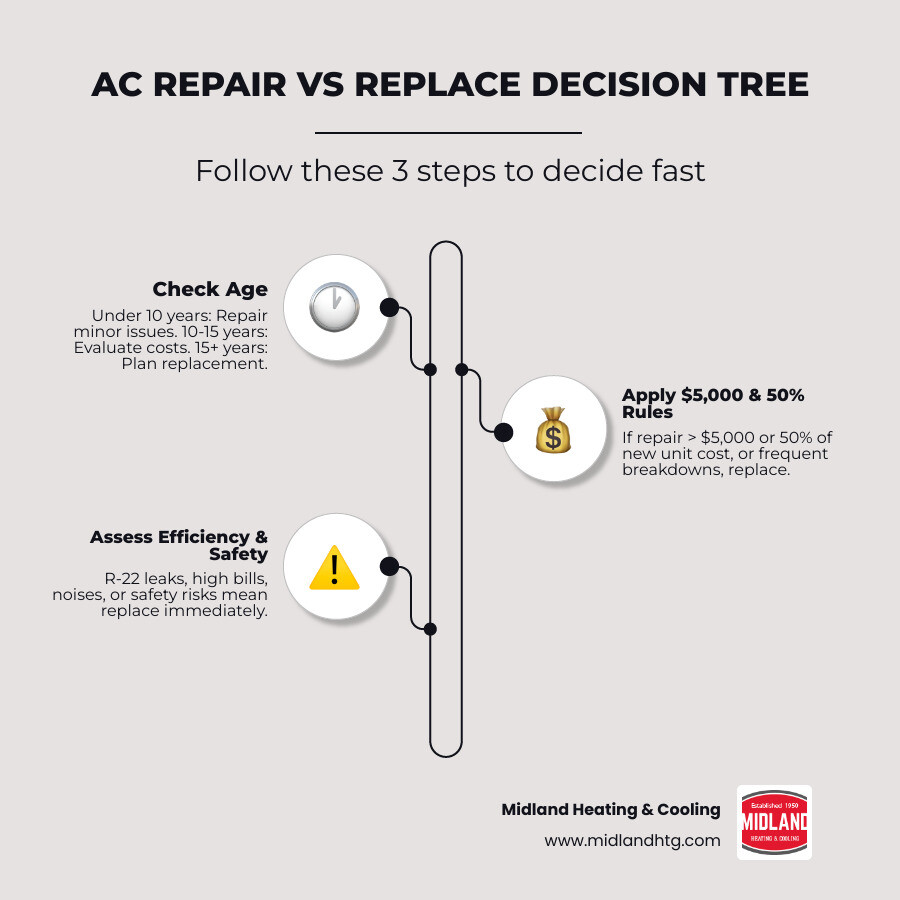
| Situation | Recommendation |
|---|---|
| Unit is under 10 years old, minor repair needed | Repair |
| Unit is 10–15 years old, repair costs are moderate | Evaluate using the $5,000 Rule |
| Unit is 15+ years old, major component failure | Replace |
| Repair cost exceeds 50% of a new system’s price | Replace |
| Unit uses R-22 refrigerant and has a leak | Replace |
| Safety issues present (carbon monoxide, fire risk) | Replace immediately |
For most Twin Cities homeowners, a central AC unit lasts somewhere between 10 and 15 years — though our humid summers and harsh winters can push systems toward the shorter end of that range. When yours starts acting up, the pressure to make a fast decision is real, especially in the middle of a hot July.
But rushing that decision can cost you. Spending money on a repair that only delays the inevitable is a frustrating and common mistake. So is replacing a unit that had years of good cooling left in it.
This guide walks you through exactly how to make the right call — using proven decision rules, real efficiency data, and practical questions to ask before you commit either way.
Understanding the Average Lifespan of AC Units in the Twin Cities
In a perfect world, your air conditioner would hum along forever. In the real world — and specifically in the Twin Cities — central air conditioners generally have a functional lifespan of 10 to 15 years. While some “overachiever” units in milder climates might stretch to 20 years, our local weather patterns in places like Minnetonka and St. Paul put unique stresses on HVAC equipment.
The freeze-thaw cycles of our winters can stress the outdoor metal components, while our humid summers mean your evaporator coils are constantly damp. This moisture can accelerate corrosion, leading to refrigerant leaks long before the mechanical parts actually wear out. If your unit is crossing the 10-year threshold, it has officially entered its “middle age.”
Maintenance history plays a massive role here. A system that has received professional tune-ups every spring is much more likely to hit that 15-year mark than one that has been neglected. If you aren’t sure how old your unit is, you can usually find the manufacture date on the nameplate of the outdoor condenser. If you are seeing Signs AC Needs Replacement This Winter, such as rust on the cabinet or a struggling compressor, it’s a signal that the internal components are degrading.
We often tell our neighbors in Minneapolis that an aging AC is often like an old car; at a certain point, the parts are simply wearing out due to time and friction. For more details on maintaining your system to avoid early failure, check out our Minneapolis AC Repair Ultimate Guide. It is also worth noting that if your AC is struggling, your furnace might be too, as they often share the same blower motor and ductwork. Keep an eye out for Signs You Need Furnace Repair to ensure your entire home comfort system is healthy.
The Mathematical Approach: Using the $5,000 and 50% Rules
When emotions are high because your house is 85 degrees inside, math is your best friend. We use two primary industry standards to help homeowners in Bloomington and Edina decide if a repair is a sound investment or just “throwing good money after bad.”
The 50% Rule is the simplest: If the cost of a single repair exceeds 50% of the price of a brand-new system, you should almost always choose replacement. For example, if a major component like a compressor fails on an older unit, the labor and parts can be significant. When that bill starts looking like half of a new, warrantied system, the ROI (Return on Investment) for the repair simply isn’t there.
Another variation used by many experts is the 30-40% Rule. This suggests that if a repair costs more than 30-40% of a new system — especially on a unit that is already 10 years or older — replacement is the wiser financial move. If you are currently facing a breakdown, our team provides AC Repair Bloomington MN to help diagnose these issues and give you the hard numbers you need for this calculation.
For those looking for Quick Reliable AC Repair Services, we always aim to provide transparent options. Sometimes, Affordable AC Services mean a simple capacitor fix that keeps a 7-year-old unit running for another five years. Other times, it means being honest about why a major repair doesn’t make sense.
Applying the $5,000 Rule to Your AC Repair vs Replace — Decision Guide
The most famous formula in the HVAC world is the $5,000 Rule. It’s an objective way to view the viability of your system.
The Formula: Age of Unit × Cost of Repair = Total Score
If your total score is over $5,000, the recommendation is to replace the unit. If it is under $5,000, a repair is likely worth the investment.
- Scenario A: You have an 8-year-old unit with a $400 repair. (8 × 400 = 3,200). Repair it.
- Scenario B: You have a 12-year-old unit with a $600 repair. (12 × 600 = 7,200). Replace it.
This formula works because it accounts for the “remaining life” of the system. Spending $600 on a unit that is likely to fail again in a year or two is a poor use of your home maintenance budget. This is especially true for those considering AC Replacement Edina MN, where modern high-efficiency units can start paying for themselves through lower monthly bills immediately.
Critical Signs It’s Time for an AC Replacement in Minneapolis
Aside from the math, your AC will often “talk” to you through its performance. If you are noticing any of the following “red flags,” it’s time to look at the ac repair vs replace — decision guide more closely:
- Inconsistent Temperatures: Are there “hot spots” in your Wayzata home? If one room is freezing while the kitchen is sweltering, your AC may no longer be able to push air effectively through the coils or ductwork.
- Rising Energy Bills: Have your utility bills jumped by 15% or more compared to the same month last year? As units age, they have to work harder and run longer to achieve the same cooling, which drains your wallet.
- Frequent Breakdowns: If you’ve had to call for service more than twice in the last two seasons, you aren’t just paying for repairs; you’re paying for the “inconvenience tax.”
- Unusual Noises: Grinding, squealing, or banging sounds are the AC equivalent of a cry for help. These often indicate a failing motor or a compressor that is about to seize.
- Humidity Issues: A key job of your AC is dehumidification. If your home in Eden Prairie feels “sticky” even when the air is cool, the system is failing to manage moisture. You might need AC Replacement Eden Prairie MN to restore comfort.
- Short Cycling: If the unit turns on and off every few minutes, it’s putting massive electrical strain on the system and failing to cool the home.
Safety is the ultimate deal-breaker. While AC units are generally safer than furnaces, electrical fire hazards from frayed wiring or overheating motors are real risks. Furthermore, if you are looking at AC Replacement Hopkins MN, your cooling and heating systems are often linked. Safety risks like carbon monoxide are more common in furnaces, so if you are replacing one, it is often the best time to When to Consider Furnace Replacement for the entire system to ensure total home safety.
Efficiency and Environmental Factors: SEER2 and the R-22 Phase-Out
In May 2026, two major factors are pushing Twin Cities homeowners toward replacement more than ever before: energy efficiency standards and the total phase-out of old refrigerants.
The R-22 Factor If your unit was manufactured before 2010, there is a high chance it uses R-22 refrigerant (often called Freon). The EPA officially banned the production and import of R-22 in 2020. By 2026, the remaining stockpiles are incredibly scarce and expensive. If an R-22 system develops a leak, the cost to recharge it can be astronomical — often costing more than a significant portion of a new unit. In almost every case, a leak in an R-22 system is the “death knell” for that air conditioner.
SEER2 and Energy Savings Modern units are measured by SEER2 (Seasonal Energy Efficiency Ratio 2). While older units might have a rating of 10 or lower, new high-efficiency systems often reach 16, 18, or even 20+ SEER2. Upgrading to an ENERGY STAR certified unit can save you 20% to 40% on your monthly cooling costs. For residents seeking AC Replacement St. Louis Park MN, these savings add up fast over a decade.
There are also significant incentives available in 2026, including federal tax credits and local utility rebates for installing high-efficiency equipment. These can significantly offset the initial investment. If you are also considering Furnace Replacement Minneapolis MN, doing both at once often qualifies you for even larger rebates and ensures your indoor and outdoor units are perfectly matched for maximum efficiency.
Why Efficiency Matters in Your AC Repair vs Replace — Decision Guide
Efficiency isn’t just about the environment; it’s about your daily comfort. Modern systems often utilize variable-speed technology. Unlike older units that are either “100% on” or “off,” variable-speed units can run at 30% or 50% capacity. This allows them to run longer, quieter cycles that do a much better job of removing humidity and maintaining a rock-steady temperature.
When you combine this with a smart thermostat, you gain unprecedented control over your home’s climate. You can reduce energy waste by scheduling cooling only when you are home, and some systems can even alert us if they detect a performance drop before a total breakdown occurs.
Making the Final Choice: An AC Repair vs Replace — Decision Guide
Making the final decision requires a professional eye. While the math and signs we’ve discussed are great indicators, a certified technician can perform a “load calculation” to ensure your system is properly sized for your home. An undersized unit will run constantly and die young, while an oversized unit will “short cycle,” leaving your home humid and your energy bills high.
When we visit homes in Excelsior or St. Louis Park, we look at the whole picture: the ductwork, the insulation, and the windows. We want to give you an unbiased recommendation based on what makes sense for your family’s budget and long-term plans.
Questions to Ask Your HVAC Professional:
- What is the exact SEER2 rating of the proposed new unit versus my current one?
- Does my current ductwork need a static pressure test before we install a new system?
- Are there specific utility rebates or tax credits I should apply for?
- What is the warranty period for the repair versus a full replacement?
- How much will I realistically save on my monthly bills with a new system?
Finding a trusted dealer is about more than just a quote; it’s about finding a partner who understands the Twin Cities climate. Look for companies with decades of local experience and technicians who are paid to solve problems, not just earn commissions on sales.
Frequently Asked Questions about AC Repair vs Replacement
How does the age of the AC system factor into the repair vs. replace decision?
Age is the primary predictor of future failure. Once a system hits 10 years, the probability of major component failure (like the compressor or evaporator coil) increases significantly. Even if a 12-year-old unit can be “fixed” with a small part today, the internal wear and tear means another part is likely to fail soon. We generally recommend looking at replacement once a unit exceeds its 12th birthday, especially if it hasn’t been perfectly maintained.
Why is R-22 refrigerant a major factor pushing for replacement in 2026?
R-22 is obsolete. Because it is no longer produced, the cost to fix a leak is prohibitively expensive. Furthermore, R-22 units are significantly less efficient than modern R-410A or newer A2L refrigerant systems. Investing money into a system that uses an illegal-to-manufacture gas is generally a poor financial decision in 2026.
What is the $5,000 Rule and how does it work for homeowners?
The $5,000 Rule is a simple math formula: multiply the age of your unit by the cost of the repair. If the result is more than $5,000, you should replace the unit. For example, a $500 repair on a 12-year-old unit equals $6,000 — signaling that replacement is the better value. It helps remove the emotion from the decision and focuses on the actual value of the investment.
Conclusion
Deciding whether to fix your air conditioner or replace it entirely is one of the biggest maintenance hurdles a homeowner faces. Whether you are in Hopkins, Wayzata, or anywhere in the Twin Cities, the goal is always the same: reliable, affordable comfort.
At Midland Heating & Cooling, we’ve been helping our neighbors navigate these choices for over 70 years. As a local, family-owned business, we value the trust of our community above all else. Our certified technicians provide honest assessments, helping you apply the rules of this ac repair vs replace — decision guide to your specific situation. We don’t just want to fix your AC; we want to make sure you have a home comfort system that serves you faithfully for years to come.
If you’re stuck in the heat and aren’t sure which way to turn, let us help. We can provide a detailed audit of your system and help you weigh the long-term ROI of a modern, efficient upgrade. Explore our Midland Heating & Cooling Air Conditioning Services to see how we can keep your home cool and your energy bills low.