

Is a 15-Year-Old AC Worth Fixing in Minnesota? Here’s the Quick Answer
If you’re wondering whether is a 15 year old ac worth fixing in Minnesota, the short answer depends on a few key factors — but in most cases, a unit at this age is right at the tipping point where replacement often makes more sense than repair.
Here’s a fast breakdown to help you decide:
| Situation | Recommendation |
|---|---|
| Unit is 15 years old with a minor, inexpensive repair | Evaluate carefully — may still be worth fixing |
| Unit is 15 years old and uses R-22 refrigerant | Replace — refrigerant is no longer produced |
| Repair cost × age exceeds $5,000 | Replace |
| Unit has needed multiple repairs in the past 2 years | Replace |
| Unit is 15 years old and running fine with low bills | Monitor, but plan for replacement soon |
Minnesota’s climate is uniquely hard on cooling systems. The swing from subzero winters to humid, 90-degree summers puts stress on refrigerant lines, compressor seals, and outdoor components during the long months your AC sits dormant. Most air conditioners last 10 to 15 years with proper maintenance — and at 15 years, a Twin Cities unit has likely absorbed the full force of that freeze-thaw punishment. For many homeowners in the Minneapolis–St. Paul area, that aging system sitting in the backyard is quietly becoming a liability rather than an asset.
Before you approve another repair bill, it’s worth understanding exactly where your system stands — and what your real options are.
Is a 15 year old ac worth fixing in minnesota?
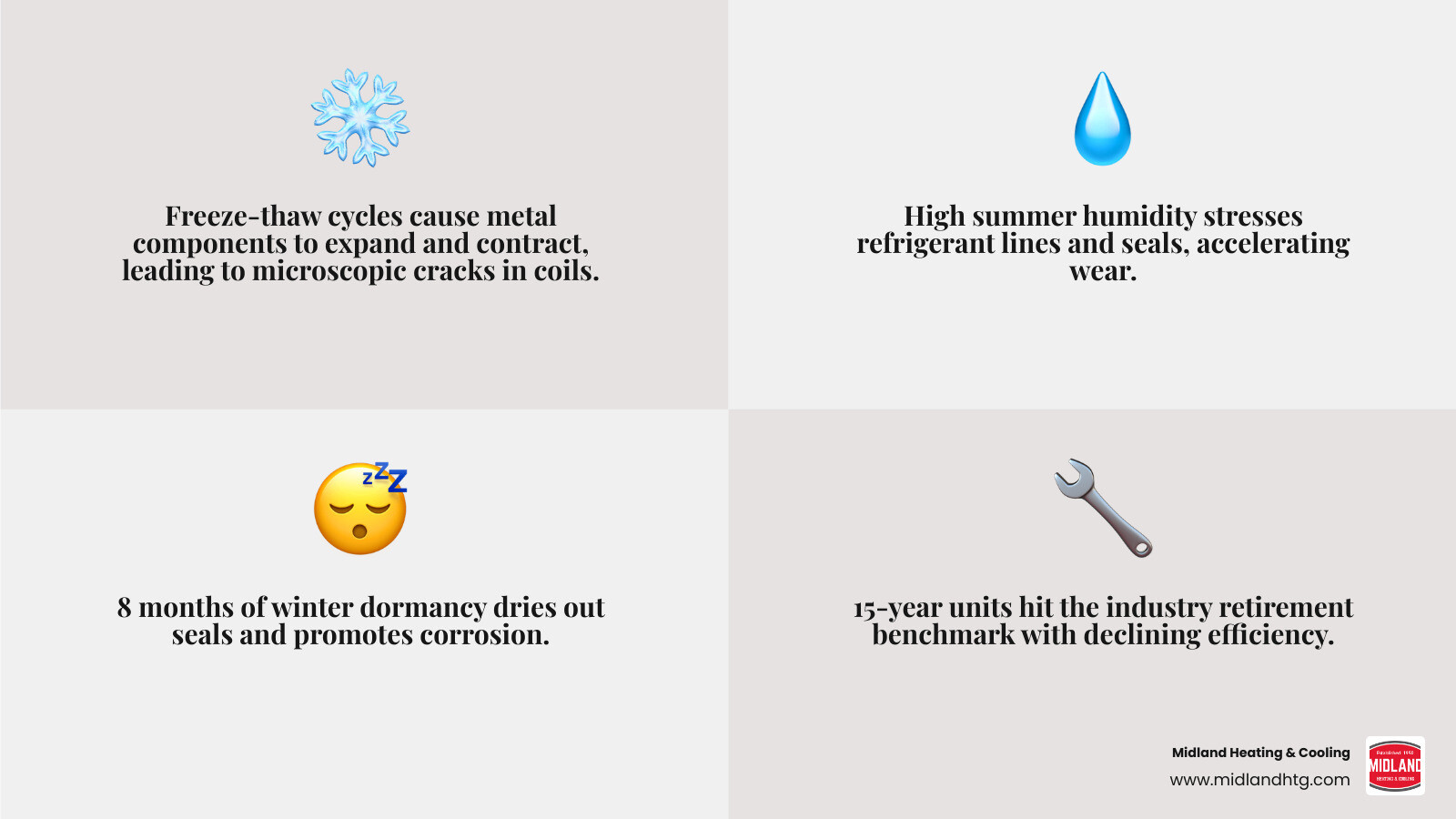
When we look at the 10-15 year benchmark, we aren’t just picking a number out of a hat. In the HVAC industry, this is the “retirement age” for most residential cooling equipment. In Minnesota, our systems face a specific type of mechanical wear that units in Florida or Arizona don’t experience. While those southern units run almost year-round, our units sit dormant for nearly eight months of the year.
This dormancy isn’t a “rest” for the machine; it’s a period of intense environmental stress. The freeze-thaw cycles common in Minneapolis and St. Paul cause metal components to expand and contract repeatedly. This can lead to microscopic cracks in the aluminum or copper coils and can cause seals to dry out and leak. By the time a unit reaches 15 years, it has survived 15 brutal winters and 15 humid, sticky summers.
At this age, the internal components like the compressor and the fan motor have logged thousands of hours. Even if the unit is still running, it is likely operating at a significantly lower efficiency than it did on day one. If you are starting to notice signs ac needs replacement this winter, such as the unit struggling to keep up with the humidity or making more noise than usual, it’s a signal that the mechanical integrity is fading.
The Mathematical Approach to Repair vs. Replace
We know that deciding whether to fix or swap an AC can feel like a gamble. To take the emotion out of the decision, we often recommend using the $5,000 Rule. This is a simple formula used by professionals to determine the financial viability of a repair.
The Formula: Multiply the age of your unit by the repair estimate. If the total is more than $5,000, you should strongly consider replacement.
- Example A: Your 15-year-old AC needs a $400 repair. (15 x 400 = 6,000). Since 6,000 is greater than 5,000, the math suggests replacement is the wiser investment.
- Example B: Your 8-year-old AC needs a $300 repair. (8 x 300 = 2,400). Here, a repair makes perfect sense.
Another guideline is the 50% Rule: If a single repair costs more than half the price of a brand-new system, it’s time to stop patching the old one. Frequent repairs are also a red flag. If you’ve had a technician out twice in the last two summers, you’re likely throwing “good money after bad.” You can find more details on navigating these situations in our Minneapolis ac repair ultimate guide.
Determining if a 15 year old ac worth fixing in minnesota makes financial sense
One of the biggest financial hurdles for a 15-year-old unit is the refrigerant it uses. Most units installed before 2010 use R-22 (often called Freon). Because R-22 has been phased out due to environmental regulations, the supply is extremely limited and the price has skyrocketed.
If your 15-year-old unit has a refrigerant leak, “recharging” it can be prohibitively expensive. You are essentially paying a premium for a substance that will eventually leak out again. In these cases, repairing the unit is almost never the right move. Furthermore, finding replacement parts for older models becomes increasingly difficult as manufacturers shift their focus to modern SEER2 compliant components. When you weigh the high cost of obsolete refrigerant against the long-term ROI of a new, warrantied system, the choice becomes much clearer. For those currently facing a breakdown, our hvac/minneapolis mn 3/ac repair services can help diagnose exactly which refrigerant your system uses.
Efficiency Standards and Modern Technology in 2026
As of May 2026, the HVAC industry has fully embraced SEER2 (Seasonal Energy Efficiency Ratio 2) ratings. These new standards are more rigorous than the old SEER ratings. A 15-year-old unit likely had a SEER rating of 10 or 13 when it was new. Today, even “entry-level” systems are significantly more efficient, often reaching 16 to 20+ SEER2.
Modern technology has also introduced inverter technology and variable-speed fans. Unlike your old 15-year-old unit, which likely only had two modes (100% ON or 100% OFF), modern systems can adjust their output in tiny increments. This allows them to maintain a perfectly steady temperature and, more importantly for Minnesota, remove significantly more humidity from the air. This results in a home that feels cooler at a higher thermostat setting. If you’re exploring these high-tech options, you can see what’s available through hvac/minneapolis mn 3/ac replacement.
Why a 15 year old ac worth fixing in minnesota often leads to higher bills
Efficiency isn’t just a buzzword; it’s a direct reflection of your monthly utility costs. Over 15 years, an AC unit naturally loses efficiency as coils become pitted and motors wear down. This “efficiency degradation” means your unit has to run longer and work harder to achieve the same cooling effect.
Upgrading to a new system can often reduce cooling-related energy consumption by 20% to 40%. For a home in St. Louis Park or Edina, that adds up to hundreds of dollars in savings every summer. Newer systems are also designed to work seamlessly with smart thermostats, allowing for better scheduling and remote control that older systems simply can’t support. If you are tired of watching your summer bills climb, check out our options for hvac/st louis park mn/ac replacement.
Critical Signs Your System is Reaching Retirement
Sometimes the math isn’t the only thing telling you it’s time to move on. Physical symptoms of a failing system are often quite obvious if you know where to look.
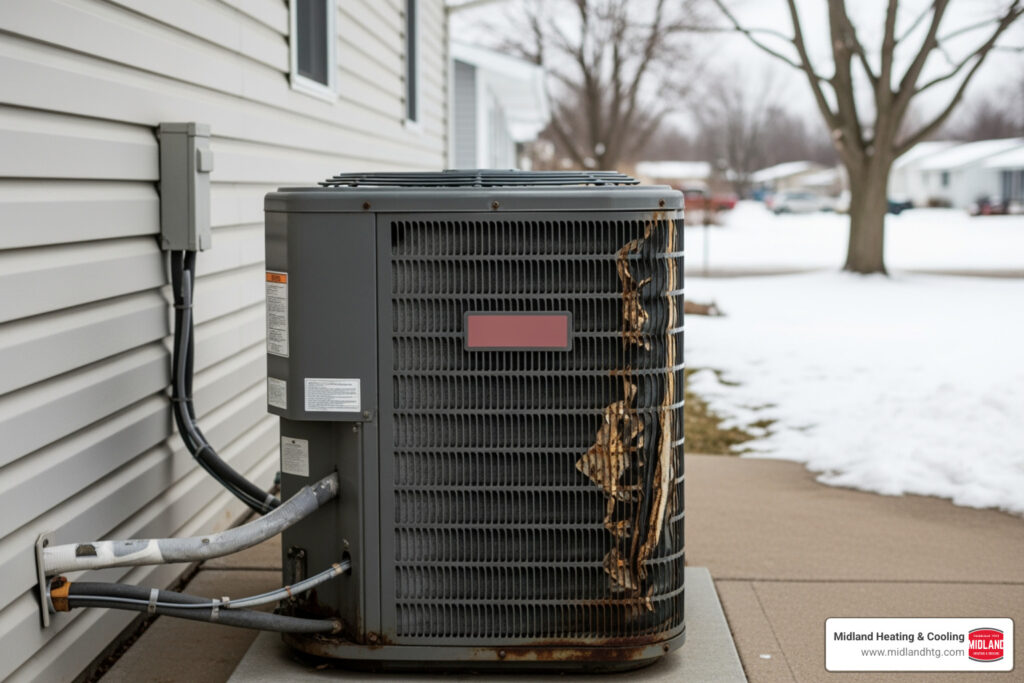
- Corroded Coils: If the fins on your outdoor unit are crumbling or look like they’ve been “eaten” away, the heat transfer capability is gone.
- Uneven Cooling: If the upstairs is a sauna while the basement is an icebox, your aging blower motor or compressor may no longer be able to move air and refrigerant effectively.
- Strange Noises: Squealing, grinding, or loud “clunks” upon startup are signs of mechanical failure in the compressor or fan motor.
- Frequent Cycling: If the unit turns on and off every few minutes, it’s “short-cycling,” which puts immense strain on the electrical components.
If you notice these issues, it’s best to get a professional opinion before the unit fails completely on a 95-degree July afternoon. You can learn more about these warning signs in our guide on signs hvac system needs professional repair.
Should you replace the entire HVAC system at once?
This is one of the most common questions we get in the Twin Cities. Because our furnaces and AC units often share the same blower motor and ductwork, they are designed to work as a “matched system.”
If your AC is 15 years old, your furnace is likely of a similar vintage. Replacing just the outdoor AC unit while keeping an old, inefficient indoor furnace can actually handicap the new unit. The old furnace fan may not be able to provide the airflow required for a high-efficiency SEER2 air conditioner, effectively “throttling” the performance you just paid for. Furthermore, replacing both at once saves significantly on labor costs. We often suggest that homeowners look at the big picture and when to consider furnace replacement as part of their long-term home comfort plan.
Local Incentives and Environmental Considerations
The good news for Minnesota homeowners in 2026 is that there has never been more financial support for upgrading to eco-friendly systems. Under the Inflation Reduction Act, federal tax credits can cover a significant portion of the cost for high-efficiency central air units and heat pumps.
Additionally, local utility providers in areas like Bloomington, Eden Prairie, and Wayzata offer substantial rebates for installing ENERGY STAR® certified equipment. These incentives are designed to encourage the move away from old, ozone-depleting refrigerants toward sustainable cooling solutions. If you are in the southern metro, our team can help you navigate ac repair bloomington mn or replacement options that qualify for these local perks.
Frequently Asked Questions about Aging AC Units
Does Minnesota’s humidity shorten an AC’s life?
Yes. Humidity makes the air “heavier” and harder to move, forcing the AC to work harder to remove moisture. In the Twin Cities, especially near lakes like Minnetonka, the high moisture content can also accelerate the corrosion of outdoor coils.
Is it possible to switch to a heat pump?
Absolutely. In fact, many Minnesotans are switching to “dual-fuel” systems where an electric heat pump handles the cooling and mild-weather heating, while a gas furnace takes over during our “Polar Vortex” weeks. This is often the most efficient way to stay comfortable year-round.
How often should I maintain an older unit?
If you have a 15-year-old unit and you aren’t ready to replace it, you should have it professionally maintained every single spring. At this age, a small issue like a dirty coil or a failing capacitor can quickly spiral into a catastrophic compressor failure.
Conclusion
At Midland Heating & Cooling, we’ve spent over 70 years helping our neighbors in Minneapolis, St. Paul, and the surrounding suburbs stay comfortable. We understand the unique challenges of the Minnesota climate, and we know that the decision of whether is a 15 year old ac worth fixing in minnesota is never easy.
Whether you need a last-ditch repair to get through the season or you’re ready to explore the quiet, efficient world of modern SEER2 cooling, our family-owned team is here to provide honest, expert advice without the pressure. We serve everyone from Minnetonka to Woodbury, ensuring your home remains a sanctuary from the summer heat.
Schedule your professional AC evaluation today and let us help you find the coolest path forward.