

Why Your AC Keeps Turning On and Off Repeatedly — and What It Means for Your Home
If your AC keeps turning on and off repeatedly, something is wrong — and it needs your attention before it becomes a much bigger problem. This pattern is called short cycling, and it’s one of the most common AC complaints homeowners in the Twin Cities deal with as cooling season kicks into gear in May 2026.
Here are the most common reasons your AC is short cycling:
- Dirty air filter — restricts airflow, causes overheating, and forces the system to shut down early
- Thermostat problems — dead batteries, bad placement near heat sources, or faulty calibration send wrong signals
- Low refrigerant — a leak causes pressure to drop, triggering an automatic safety shutoff
- Oversized AC unit — cools the space too fast, shuts off before completing a full cycle
- Frozen evaporator coils — ice buildup blocks airflow and causes repeated shutdowns
- Faulty capacitor or electrical issue — prevents the system from starting or staying on
- Clogged condensate drain line — a float switch shuts the unit off when water backs up
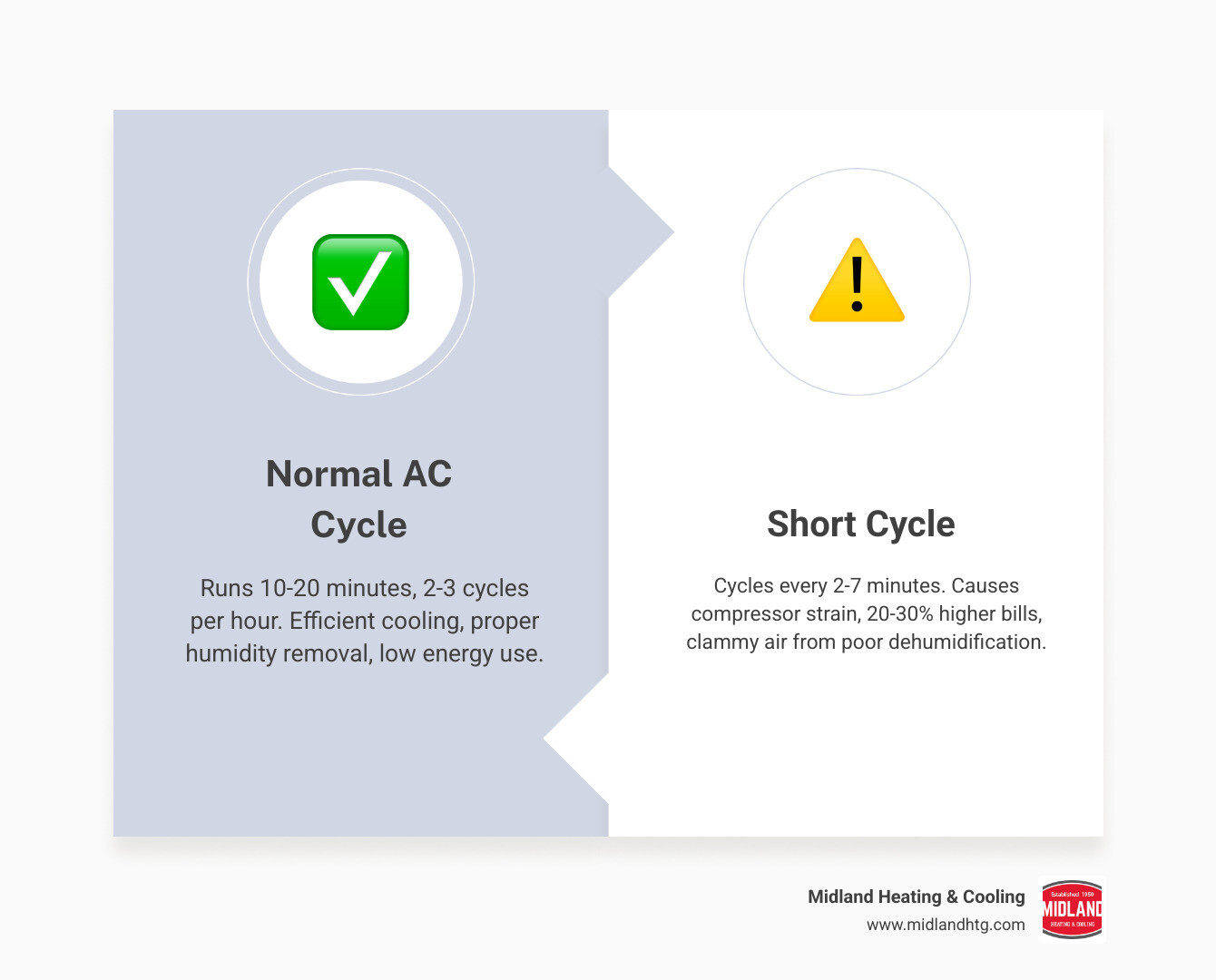
A healthy AC should run for 10 to 20 minutes per cycle, completing about 2 to 3 cycles per hour on a warm day. If your system is cycling every 2 to 7 minutes, that’s short cycling — and every extra startup strains your compressor, drives up your energy bill, and shortens your system’s life.
The good news: some causes are simple DIY fixes. Others need a licensed HVAC technician. This guide walks you through both.
AC Keeps Turning On and Off Repeatedly: What is Wrong with My System?
When we talk about short cycling, we aren’t just talking about a minor annoyance. Think of your air conditioner like a car: it uses the most energy when it first starts up. If your ac keeps turning on and off repeatedly what is wrong usually boils down to the system being forced into a “startup loop.”
Because the startup phase requires a massive surge of power, short cycling can lead to a 20-30% increase in your monthly energy bills. Beyond the cost, your home’s comfort suffers. Air conditioners don’t just cool the air; they remove humidity. A system that only runs for five minutes never gets the chance to pull moisture out of the air, leaving your home feeling “clammy” or sticky, even if the temperature on the wall looks correct.
Furthermore, this behavior is a death sentence for your compressor—the most expensive part of your system. A compressor is designed to run for steady periods. Constant stopping and starting causes extreme wear and tear, often leading to a premature system failure years before its expected 12-15 year lifespan. If you are noticing these symptoms, Troubleshooting Ac Short Cycling should be your top priority to save your equipment.
Airflow Obstructions: Why Your AC Keeps Turning On and Off Repeatedly and What is Wrong with the Filter
In our 70+ years of serving the Twin Cities, we’ve found that a dirty air filter is the #1 cause of short cycling, resolving the issue roughly 40% of the time.
When a filter is clogged with dust, pet hair, and Minneapolis allergens, your AC can’t “breathe.” This lack of airflow causes the internal temperature of the unit to spike. To prevent the motor from melting down, a safety sensor trips and shuts the system off. Once it cools down slightly, it tries to start again, and the cycle repeats. This restricted airflow can also cause the evaporator coils to drop below freezing, turning condensation into a block of ice. If you find your Ac Fan Not Working properly or air barely moving through the vents, check these airflow checkpoints:
- The Filter: Is it gray or covered in a thick layer of dust?
- The Vents: Are furniture, rugs, or curtains blocking your supply or return registers?
- The Outdoor Unit: Are there leaves or debris packed against the metal fins?
- The Ductwork: Are there visible collapses or leaks in the exposed ducts in your basement?
Thermostat Malfunctions: AC Keeps Turning On and Off Repeatedly and What is Wrong with the Settings
Sometimes the “brawn” of your AC is fine, but the “brain”—the thermostat—is confused. If your thermostat is reading the temperature incorrectly, it will tell the AC to shut down before the house is actually cool.
One common culprit is improper placement. If your thermostat is located in direct sunlight, near a drafty window in Minnetonka, or right next to a heat-producing appliance like an oven or a lamp, it will think the house is much hotter than it is. It kicks the AC on, feels a quick blast of cold air from a nearby vent, thinks the job is done, and shuts off.
Additionally, we often see Signs Smart Thermostat Needs Attention when Wi-Fi models lose their connection or display Common Smart Thermostat Error Messages. Even low batteries can cause a thermostat to “flicker” its signal, causing the AC to start and stop erratically.
Mechanical and Electrical Failures Behind Frequent Cycling

If your filters are clean and your thermostat is set correctly, the issue might be under the hood.
Refrigerant Leaks: Your AC uses refrigerant to move heat from inside to outside. It isn’t “fuel” that gets used up; it stays in a closed loop. If there is a leak, the pressure drops. Most modern units have a low-pressure switch that shuts the compressor off to prevent it from burning out when refrigerant is low. This results in the system clicking on, realizing the pressure is wrong, and clicking right back off.
Frozen Evaporator Coils: As mentioned earlier, poor airflow can cause coils to freeze. However, low refrigerant can also cause this. Once the coils are a block of ice, the system can’t exchange heat and will cycle off. You might notice Ac Thermostat Problems In Humid Weather more frequently because high humidity provides more moisture to turn into ice on those cold coils.
Electrical Failures: Your AC has a “run capacitor” that acts like a battery to give the motor the extra “oomph” it needs to stay running. If this capacitor is failing, the AC might start but then lose power seconds later.
| Symptom | Likely Cause |
|---|---|
| Hissing or bubbling noises | Refrigerant Leak |
| AC turns off after 30 seconds | Faulty Capacitor |
| Visible ice on copper lines | Airflow or Refrigerant Issue |
| Burning smell or tripped breaker | Electrical Wiring Fault |
The Hidden Issue of Oversized AC Units
In the HVAC world, “bigger” is definitely not “better.” If you recently had a new system installed in Edina or Eden Prairie and it has short cycled since day one, the unit might be too large for your square footage.
HVAC professionals use a Manual J calculation to determine the exact cooling load of a home. If an AC is too powerful, it blasts the house with cold air so quickly that the thermostat reaches its goal in 5 minutes. While the air feels cold, the system hasn’t run long enough to remove the humidity. This leads to Ac Running Constantly Without Cooling Properly or, more accurately, cycling so often that the home feels “clammy.”
In May 2026, as we see more extreme temperature swings in the Twin Cities, proper sizing is essential. An oversized unit will fail years earlier than a properly sized one because of the thousands of extra startups it performs every season.
DIY Steps to Stop Short Cycling Before Calling a Pro
Before you pick up the phone to call us for a repair in Bloomington or St. Louis Park, try these simple troubleshooting steps. You might save yourself a service call!
- Change the Filter: This is the most common fix. Even if it looks “okay,” try a fresh one.
- Check the Thermostat Batteries: Replace them with brand-name alkaline batteries.
- Clear the Vents: Walk through every room. Ensure no furniture or rugs have been moved over the registers.
- Inspect the Outdoor Condenser: Ensure there are at least two feet of clear space around the unit. Clear away tall grass, weeds, or fallen branches.
- Check the Float Switch: Look at the white PVC pipe coming off your indoor unit. If there is a little switch with wires coming out of it and you see standing water in the pipe, your drain line is clogged. You can sometimes use a wet/dry vacuum to suction the clog out from the outside exit point.
- Reset the Breaker: Sometimes a simple power cycle of the HVAC breaker can clear a “glitch” in the control board.
Frequently Asked Questions About AC Cycling
We get a lot of questions at our Hvac Faqs page. Here are the most relevant ones for May 2026.
How long should a normal AC cycle last in May 2026?
A normal cycle should last between 10 and 20 minutes. On a typical May afternoon in Minneapolis, your unit should cycle about 2 to 3 times per hour. If it’s running for 5 minutes and turning off, or if it’s cycling more than 4-5 times an hour, it is short cycling.
Can a dirty outdoor unit cause the AC to turn off?
Absolutely. Your outdoor unit (the condenser) is responsible for releasing the heat collected from your home. If the coils are covered in dirt, cottonwood seeds, or grime, the heat stays trapped. This causes the system to overheat and shut down as a safety precaution.
Is short cycling a sign I need a new air conditioner?
Not always! As we’ve shown, many causes are simple repairs. However, if your unit is over 12 years old and the compressor has failed due to years of short cycling, a replacement is often more cost-effective than a multi-thousand-dollar repair on an aging system.
Conclusion
When your ac keeps turning on and off repeatedly what is wrong is usually a cry for help from your cooling system. Whether it’s a simple filter change or a complex refrigerant leak, ignoring the problem will only lead to higher bills and a broken compressor.
At Midland Heating & Cooling, we’ve been the Twin Cities’ trusted HVAC experts for over 70 years. We serve homeowners across Minneapolis, St. Paul, Edina, Minnetonka, and beyond with a commitment to 100% customer satisfaction. We know the local climate, and we know how to keep your home comfortable through the humid Minnesota summers.
If you’ve tried the DIY steps and your AC is still acting like a light switch, it’s time to call in the pros. Check out the Signs Hvac System Needs Professional Repair or simply Request Service online.
Schedule your professional cooling inspection today and let us get your AC back on a healthy cycle!