

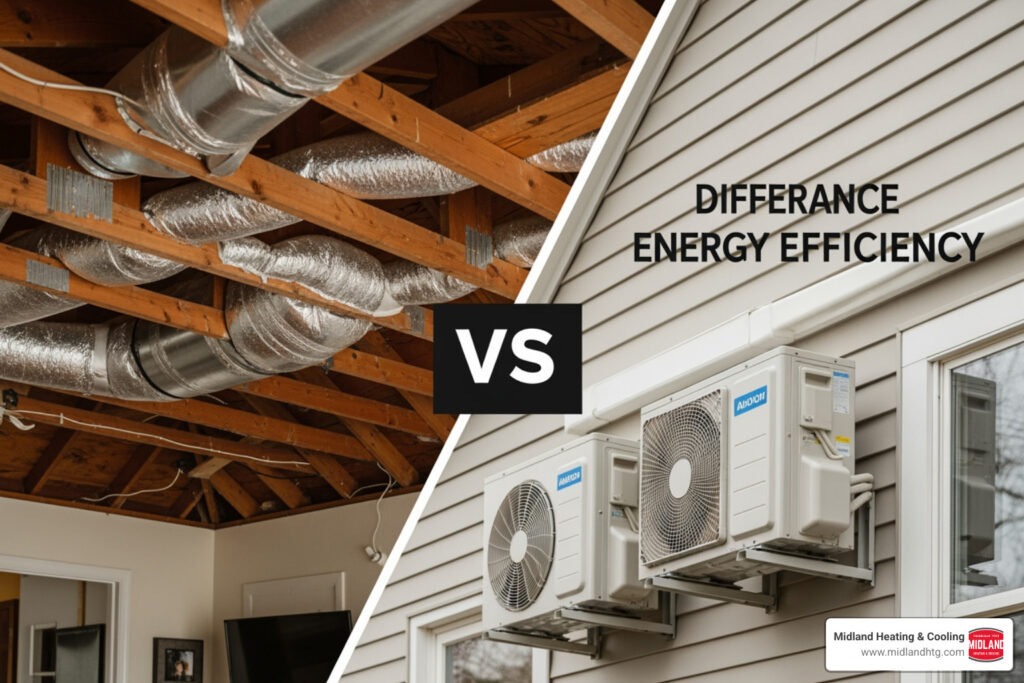
Are Mini Splits More Efficient Than Adding Ductwork to an Older Home?
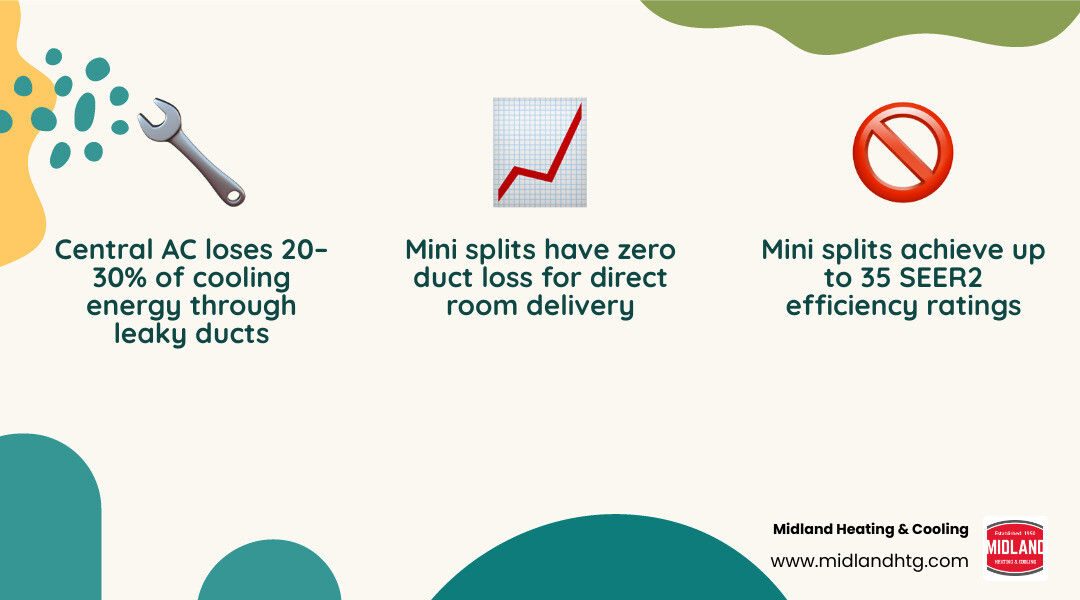
Are mini splits more efficient than adding ductwork to an older home? Yes — in most cases, significantly so. Central AC systems lose 20–30% of their cooled air through duct leaks before it ever reaches a room. Mini splits deliver conditioned air directly, with zero duct loss. Add in higher SEER2 efficiency ratings and inverter-driven technology, and the gap widens further.
Quick answer for Twin Cities homeowners:
- Duct energy loss: Central AC loses 20–30% of cooling energy through leaky or poorly insulated ducts
- Efficiency ratings: Mini splits reach up to 35 SEER2; central AC typically tops out lower
- Zero duct loss: Mini splits deliver air directly into the room — no energy wasted in walls, attics, or crawlspaces
- Zoned control: Mini splits cool only the rooms you’re using, unlike central systems that condition the whole house at once
- Historic homes: Adding ductwork to an older home often means cutting through plaster walls, dropping ceilings, or building soffits — mini splits require only a small hole in the wall
- Incentives: Qualifying mini split heat pumps are eligible for a federal tax credit of up to $2,000 through 2032
For older homes in Minneapolis — especially those built before central air was standard — the choice often comes down to a simple question: do you want to pay to move air through a leaky system hidden in your walls, or do you want to deliver it exactly where you need it?
This guide walks through the real efficiency differences, what duct loss actually costs you over time, and how to decide what makes sense for your specific home.
Are mini splits more efficient than adding ductwork to an older home?
When we look at the engineering behind modern HVAC, the question of whether are mini splits more efficient than adding ductwork to an older home becomes a matter of physics and architecture. In a traditional central air system, the ductwork acts as the “transmission” for the cooling “engine.” If that transmission is leaky, poorly insulated, or forced into tight corners of a 1920s attic, the efficiency of the unit itself almost doesn’t matter.
SEER2 Ratings: The New Gold Standard in 2026
In May 2026, we are operating under the SEER2 (Seasonal Energy Efficiency Ratio 2) standards. This rating measures how much cooling a system provides per watt of electricity used. Most modern central AC units range between 13 and 18 SEER2, with high-end models hitting 26. In contrast, premium Ductless Ac Systems For Older Homes/ can reach staggering ratings of 30 to 38+ SEER2.
The higher the number, the less you pay the utility company for the same amount of comfort. Because mini splits don’t have to push air through a massive network of pipes, they can use smaller, more efficient motors and precision-engineered coils to achieve these higher numbers.
The “Duct Loss Tax”
The most significant efficiency drain in older homes is what we call the “duct loss tax.” According to the U.S. Department of Energy, typical duct systems lose 20% to 30% of conditioned air through leaks, gaps, and poor insulation.
Imagine buying a gallon of milk, but 30% of it leaks out of the jug before you get home. That is exactly what happens when you install central air in a home not originally designed for it. The air is cooled at the condenser, but by the time it travels through a hot attic or a crawlspace to reach your bedroom, it has already lost much of its “chill.” Mini splits sidestep this entirely because the cooling happens right at the wall-mounted or ceiling-mounted unit inside the room.
Why mini splits are more efficient than adding ductwork to an older home in Minneapolis
In the Twin Cities, our climate presents unique challenges. We deal with heavy humidity in July and sub-zero temperatures in January. For a Minneapolis homeowner, efficiency isn’t just a summer concern; it’s a year-round financial reality.
When we consider if are mini splits more efficient than adding ductwork to an older home in the local context, we have to look at our historic housing stock. Whether you are in a Tudor in Edina or a Victorian in St. Paul, these homes were built to “breathe” through radiators and thick plaster walls.
- Zero Duct Loss in Humid Climates: In Minneapolis, humidity makes air feel heavier. Pushing that heavy, moist air through retrofitted ducts requires more energy. Mini splits remove moisture more effectively because they can run at lower speeds for longer periods, maintaining a steady, dry environment without the energy spikes of a central unit.
- Seasonal Performance: Most mini splits are actually heat pumps. In 2026, “Cold Climate” models are the standard for our region. They can maintain efficiency even when the Minneapolis frost kicks in, providing supplemental heat that is often 200% to 400% more efficient than electric baseboard heaters.
- The Space Factor: In neighborhoods like St. Louis Park or Southwest Minneapolis, space is at a premium. Adding ductwork often requires “stealing” space from closets or corners to build chases. Ductless Mini Split Ac Minneapolis/ solutions require only a three-inch hole for the refrigerant lines, keeping the conditioned air (and your square footage) exactly where it belongs.
“Why is my upstairs always so hot?” Solving the duct loss problem in 2026
If you live in a two-story home in Bloomington or Minnetonka, you know the struggle: the main floor is a refrigerator, while the upstairs bedrooms feel like a sauna. This is the classic “thermal bridging” problem.
In a central air retrofit, ducts are often run through the attic to reach the second floor. In July, attic temperatures in Minnesota can easily soar to 140°F. Even with insulation, those ducts are sitting in an oven. The cooled air inside the duct absorbs that heat before it ever reaches your vent. This reduces the effective efficiency of a central AC system by as much as 30%.
When you are What To Know Before Converting To Central Air/, you have to account for this “invisible” cost. You might buy a 16 SEER2 unit, but because of the heat gain in the attic ducts, it performs like a 12 SEER2 unit. Mini splits solve this by placing the cooling source directly in the upstairs rooms, ensuring that 100% of the cooling you pay for actually stays in the living space.
“Will adding ducts ruin my home’s character?” Preserving historic Twin Cities charm
One of the biggest heartaches we see as HVAC professionals is when a homeowner realizes that “going central” means building “ugly boxes” (known as soffits or bulkheads) across their beautiful crown molding or original plaster ceilings.
Older homes in areas like Wayzata or Excelsior were built with craftsmanship that is hard to replicate today. Retrofitting ductwork is an invasive surgery. Here is why mini splits are often the “preservationist’s choice”:
- No Soffits Required: You don’t have to drop ceilings or hide ducts in the corners of your dining room.
- Plaster Protection: Cutting into lath and plaster walls is messy, expensive, and can lead to structural cracking. Mini splits require only a tiny hole for the conduit.
- Closet Preservation: Central air often requires sacrificing a significant portion of your closets to run vertical duct stacks.
- Aesthetic Flexibility: In 2026, we have more than just the “white box” on the wall. We can install ceiling cassettes that sit flush with the ceiling or floor-mounted units that look like modern radiators.
For those dedicated to Central Air Installation In Historic Homes/, the aesthetic “cost” of ductwork is often higher than the financial cost. Mini splits allow you to keep the architecture that made you fall in love with the home in the first place.
“How does inverter technology improve my home’s efficiency?”
If you’ve ever used cruise control on a car, you understand inverter technology. Traditional central AC units are either “all on” or “all off.” When the thermostat hits 72 degrees, the compressor kicks on at 100% power. Once it hits 70, it slams off. This “on-off” cycling is incredibly inefficient—like floor-boarding the gas pedal at every green light and slamming the brakes at every red light.
Mini splits use inverter-driven compressors. These units can ramp up or down to match the exact cooling needs of the room. If the room only needs a tiny bit of cooling to stay comfortable, the inverter runs at a low, whisper-quiet speed.
This technology is a huge part of why Hvac/St Louis Park Mn/Mini Ductless Ac/ systems are so much cheaper to operate. By avoiding the massive energy spikes required to start a traditional compressor, you save a significant amount on your monthly Xcel or CenterPoint bill.
How inverter technology makes mini splits more efficient than adding ductwork to an older home
When we compare the two, the inverter is the secret weapon. Because mini splits are designed for Hvac/Bloomington Mn 3/Mini Ductless Ac/, they don’t have to overcome the “static pressure” of a duct system.
In a ducted home, the fan has to work incredibly hard just to push air through the vents. This creates a constant high energy draw. The inverter-driven mini split, however, delivers air directly. It can maintain a steady temperature within a fraction of a degree, whereas central systems often see a 2-to-3-degree swing. That steadiness means the system isn’t constantly playing “catch up,” which is where most of your energy dollars are wasted.
“Is there a way to only cool the rooms I’m using?” Zoned comfort benefits
Central air is like a whole-house audio system where you can’t turn off the speakers in the basement while you’re listening to music in the kitchen. If you’re sleeping in your bedroom, a central system is still trying to cool your empty living room, kitchen, and dining room.
Mini splits offer true “zoned comfort.” Each indoor head has its own thermostat. This allows for what we call “occupied space conditioning.”
- Daytime: Keep the home office and kitchen cool while letting the bedrooms stay a bit warmer.
- Nighttime: Turn off the units in the living areas and only run the units in the bedrooms you are using.
- Guest Rooms: Keep the guest suite at a neutral temperature until someone actually stays there.
This level of control can reduce cooling costs by 25% to 40% compared to central AC systems. When you look at Ductless Ac Systems In Older Homes/, the ability to “turn off” half your house is the ultimate efficiency hack.
| Feature | Central AC (with new ducts) | Ductless Mini Split |
|---|---|---|
| Energy Loss | 20-30% via duct leaks | 0% (Direct delivery) |
| Zoning | Whole-house (all or nothing) | Room-by-room control |
| Typical SEER2 | 13 – 18 (Premium up to 26) | 18 – 30+ (Premium up to 38) |
| Invasiveness | High (Cutting walls/ceilings) | Low (3-inch hole) |
| Noise Level | 40-60 dB (Vents/Fans) | 19-24 dB (Whisper quiet) |
| Heating | Requires separate furnace | Built-in Heat Pump |
“What 2026 incentives are available for Minneapolis homeowners?”
The financial landscape for HVAC in 2026 is very favorable for homeowners choosing high-efficiency systems. Because mini splits are almost always heat pumps, they qualify for the most aggressive incentives available.
- Federal Tax Credits (Section 25C): Under the Inflation Reduction Act, homeowners can claim a tax credit of 30% of the project cost, capped at $2,000 per year for qualifying heat pumps. This is a significant offset to the initial investment.
- Utility Rebates: Local providers like Xcel Energy and CenterPoint often offer tiered rebates based on the SEER2 and HSPF2 (heating efficiency) ratings of the system. The more efficient the system, the larger the rebate.
- Energy Star “Most Efficient”: Systems that meet the 2026 Energy Star “Most Efficient” criteria often trigger additional state-level incentives designed to reduce the load on the Twin Cities electrical grid during peak summer days.
By stacking these incentives, the “payback period”—the time it takes for energy savings to cover the cost of the system—is shorter than ever.
Frequently Asked Questions about Mini Split Efficiency
Do mini splits work effectively in Minnesota winters?
Yes. In 2026, we exclusively recommend “Hyper-Heat” or “Cold Climate” models for our Minneapolis and St. Paul clients. These modern systems can maintain 100% of their heating capacity down to 5°F and continue to provide efficient heat even when the temperature drops to -13°F or lower. While many homeowners keep their existing boiler or furnace as a backup for those record-breaking “Polar Vortex” nights, mini splits handle the vast majority of the heating season with much higher efficiency than traditional systems.
How long do ductless systems typically last compared to central air?
With proper maintenance, a mini split system typically lasts between 15 and 20 years. Central AC systems usually have a lifespan of 12 to 15 years. The key to longevity for a mini split is keeping the filters clean (which is a DIY task every few weeks) and having a professional check the outdoor coils and condensate drains once a year.
Are mini splits quieter than traditional ducted systems?
Significantly. A central AC vent typically operates at 40 to 60 decibels—the sound of a loud conversation or a dishwasher. Indoor mini split units operate as low as 19 to 24 decibels. To put that in perspective, a whisper is about 30 decibels. Most of our clients in Edina and Hopkins tell us they forget the units are even running until they realize how comfortable the room feels.
Conclusion
When you weigh the evidence, the answer to are mini splits more efficient than adding ductwork to an older home is clear. For the historic homes that define the Twin Cities, mini splits offer a way to achieve 21st-century comfort without destroying 20th-century charm. You avoid the “duct loss tax,” gain precision control over every room, and benefit from the most advanced inverter technology available in 2026.
At Midland Heating & Cooling, we’ve been serving this community for over 70 years. We’ve seen every type of home from Minneapolis bungalows to Minnetonka estates, and we understand that every structure has its own personality. Our certified technicians are experts in designing ductless/ solutions that maximize efficiency while respecting the integrity of your home.
Whether you’re looking to solve the “hot upstairs” problem or you’re ready to retire the window units for good, we are here to help you navigate the 2026 efficiency standards and find the perfect fit for your lifestyle. Your century home has stood the test of time—it deserves a cooling system that’s built for the future.